

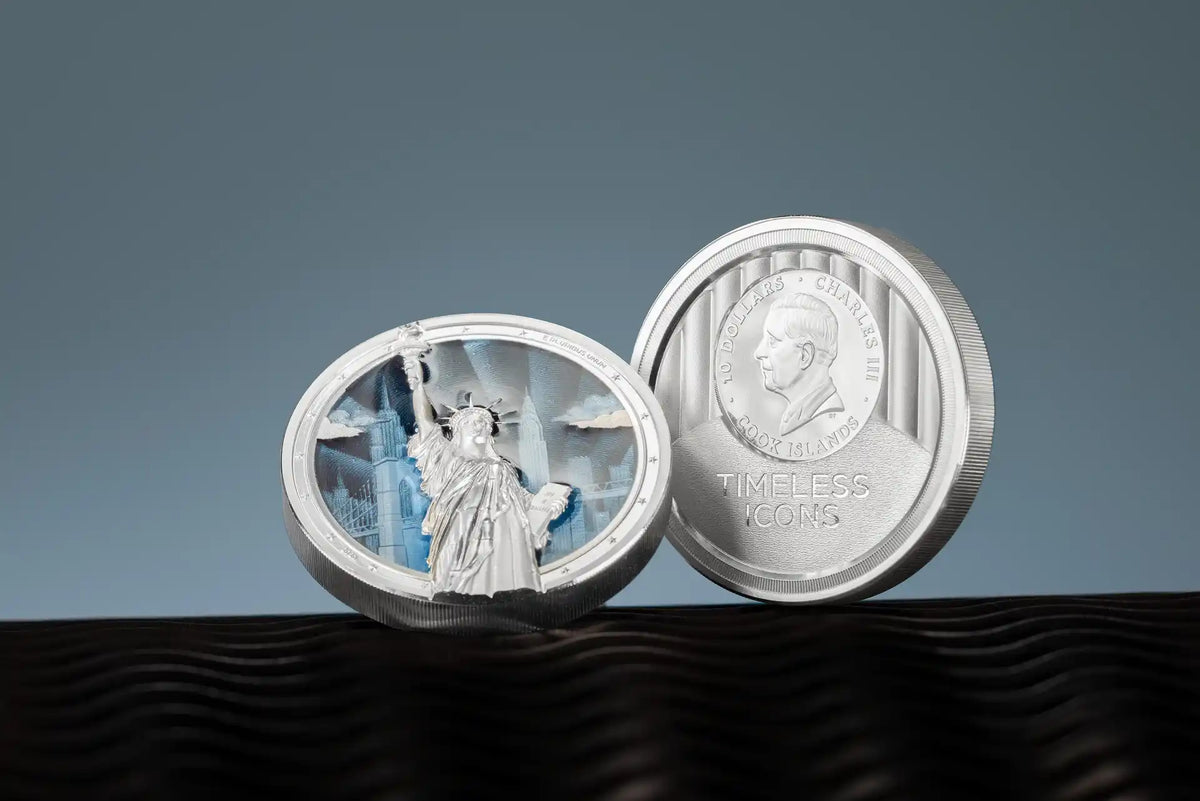
MS70 is the highest grade a coin can receive. It means the piece is uncirculated and shows no post-production flaws under 5x magnification: flawless surfaces, clean fields, and every design detail exactly as it left the press. The MS stands for Mint State, and the 70 marks the top of the scale that grading services use worldwide.
The Sheldon scale made simple
Grading gives collectors a shared vocabulary for condition. Most of the world relies on the Sheldon scale, which runs from 1 to 70. Circulated coins sit in the Poor to About Uncirculated range, while uncirculated pieces are Mint State, written as MS.
Proof coins, struck with special dies and polished planchets for sharp relief and mirrored fields, appear as PF or PR. A proof graded PF70 carries the same standard as MS70, and may add Cameo or Ultra Cameo to describe strong contrast between relief and field.
It is worth separating four terms that often get used interchangeably. The condition is the physical state of the coin. The grade is the number assigned to that state. The grading service is the independent company that makes the assessment. The certification is the sealed holder and record that follows the coin afterwards.
MS70 in the real world
Independent grading services authenticate a coin, assign a grade, and seal it in a clear, tamper evident holder. Many modern issues from countries such as Niue and Cameroon come from advanced production lines that produce brilliant finishes, yet a perfect 70 is never guaranteed. Tiny handling marks, faint spots, or subtle strike variance can drop a piece to MS69 or lower.
The number on the plastic is only part of the story. Strike strength, reflectivity, natural toning, and overall artistry all influence how a coin feels in hand.
Choosing between MS69 and MS70
Two MS70 pieces can evoke very different reactions, and many MS69 examples display superb eye appeal. That nuance leads experienced buyers to study surfaces closely and weigh narrative, mintage, and design intent alongside the numeric grade.
Plenty of collectors prefer an MS69 with luminous toning and a compelling story, directing the money saved toward another piece. A single MS70 can crown a set, while an MS69 with unforgettable presence may become the coin you reach for most often.
What a grade does and does not tell you
Grading affects several forces that shape demand.
- Confidence. A respected grade supports authenticity and condition, making resale smoother.
- Scarcity within scarcity. Even with low mintages, the share that earns MS70 can surprise you. Population reports show the true rarity of each grade.
- Registry culture. Many collectors build graded sets and compete online. Every grade point raises a registry score, so top grades attract extra attention.
- Consistency across borders. A shared scale gives buyers in different countries a stable reference when trading online or at shows.
A grade also has clear limits. It records an expert opinion at one moment, and temperature, humidity and how you store the coin continue to affect it after encapsulation. A high grade says nothing about whether the motif is worth owning, and it is never a promise about what the coin will be worth later.
Deciding what a grade is worth to you
The question is not whether MS70 is automatically better, but whether the grade supports the purpose of the coin in your cabinet. If you follow a theme, a designer's signature, or a national programme from places such as Niue or Cameroon, grading can define tiers inside that focus.
Certification adds most where surface quality is hardest to judge from a photograph, which is why mirror finished proofs benefit from it more than most. For contemporary art coins with very low mintages and layered finishes, some collectors would rather examine relief, micro text and subtle colour in hand than through sealed plastic. Both choices are defensible, and the coin itself usually tells you which one it deserves.
Dela:
What is a proof coin?
Frigg i Gods of Germania – motiv och utförande